
Technique
Flatten a Warped Board Without a Jointer
How to flatten warped or cupped stock with a planing sled, router sled, or hand planes and winding sticks—no jointer required.
Made in my shop
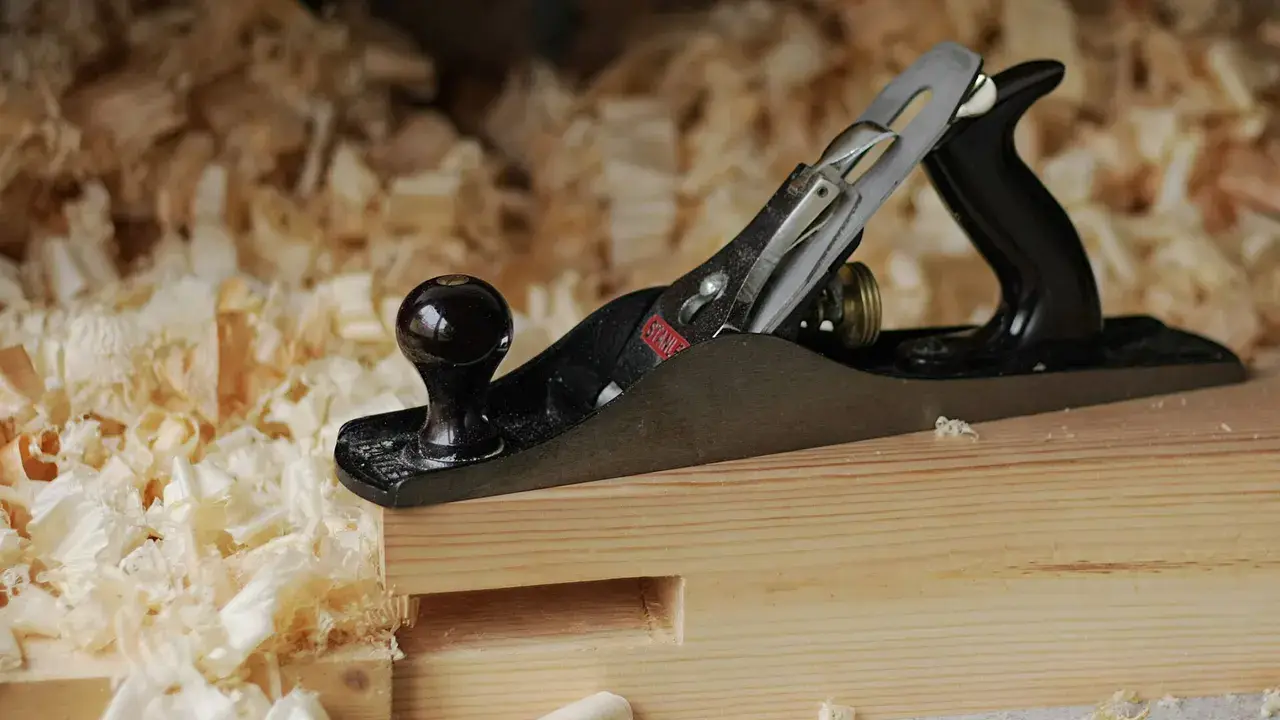
A jointer is the usual machine for the first flat face, but plenty of shops flatten warped stock without one. This tip owns the warped / no-jointer path. For the full milling order (face, edge, thickness, width, length), see flattening and squaring stock.
Follow your planer’s and router’s manuals for guards, depth of cut, and minimum stock length. Use push blocks as directed.
Why boards warp
Wood moves as moisture changes. Common shapes:
- Cup: edges high or center high across the width.
- Bow: ends high or middle high along the length.
- Twist: opposite corners high.
Rough-cut the board a little long and wide before you flatten. Shorter pieces have less twist to remove, so you keep more thickness.
Check with winding sticks
Two straight sticks across the ends of the board show twist: sight across their tops; if they are not parallel, the high corners need work first. A straightedge along, across, and diagonally shows hollows and humps. Mark high spots with chalk or a pencil before you cut.
Router sled method
A two-rail router sled works for wide slabs or when you do not own a planer:
- Fix the board so it cannot rock (shims or hot glue on a flat base).
- Raise two parallel rails beside the board, level with each other.
- A router on a bridging carriage skim-cuts the high spots in overlapping passes until the face is flat.
- Flip and thickness by planer, or skim the second face the same way with the first face registered flat.
Take shallow passes. More edge control: router basics for edges and using a router safely.
Planing sled method
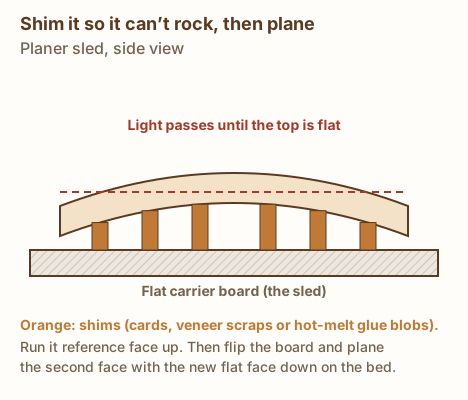
A thickness planer makes the top face parallel to whatever sits on the bed. If the bottom face is warped, the planer copies the warp. A planer sled (planing sled) fixes that:
- Start with a flat carrier board longer and a bit wider than the workpiece (Baltic birch plywood or MDF works).
- Set the warped board on the sled so it does not rock. Shim the hollows with playing cards, veneer scraps, or hot-melt glue blobs; or hot-glue the board down once it sits without rocking.
- Run the sled through the planer, reference face up, taking light passes until the top face is flat.
- Pop the board off the sled, flip it, and plane the second face to thickness with the new flat face down on the planer bed.
Keep the sled and workpiece within your planer’s capacity, and support long stock on infeed and outfeed.
Swipe sideways to see the whole diagram, or tap it to open full size.
Hand planes
- Mark high spots with winding sticks and a straightedge.
- Plane the high corners diagonally with a jack or fore plane to remove twist, then along the length to remove bow.
- Check often; stop when the straightedge shows even contact.
- When one face is flat, square an edge to it (edge jointing for panels), then thickness and rip.
Sharp irons matter: sharpening chisels and planes.
When to use which
| Situation | Method |
|---|---|
| You have a planer, board fits the bed | Planing sled |
| Wide slab or no planer | Router sled |
| Quiet shop, small boards, or practice reading grain | Hand planes |
| Heavy twist on long stock | Winding sticks first, then any method above |
Related: flattening and squaring
After the first face is flat, follow the milling order in flattening and squaring stock: square one edge, thickness, rip to width, crosscut to length. Flat faces also set you up for gap-free glue-ups and scrap cauls for flat glue-ups.
Sources & further reading
- Fine Woodworking — Essential milling machines
- Woodsmith — Top jointer technique
- Your planer’s and router’s owner’s manuals for depth of cut, guards, and push-block use
Need chisels? See our chisel picks.
Get new build ideas by email
Free build ideas and tips by email, about twice a month. We'll send a link to confirm. Our emails are sent by Kit, which tracks opens and clicks so we can see what's useful. Unsubscribe anytime. You must be 16 or older. Privacy policy.