Build idea
Laser-cut wood earrings
I made this Share a photo of your version.
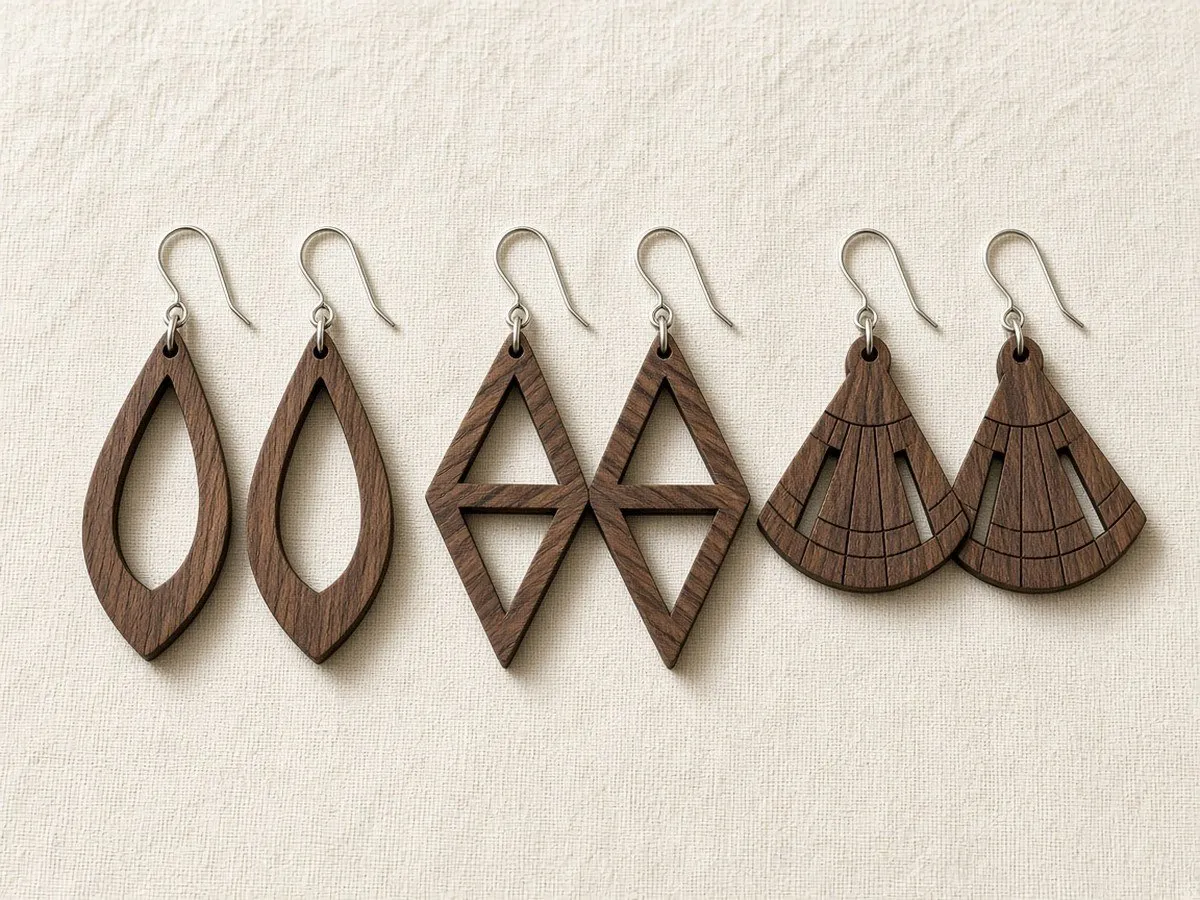
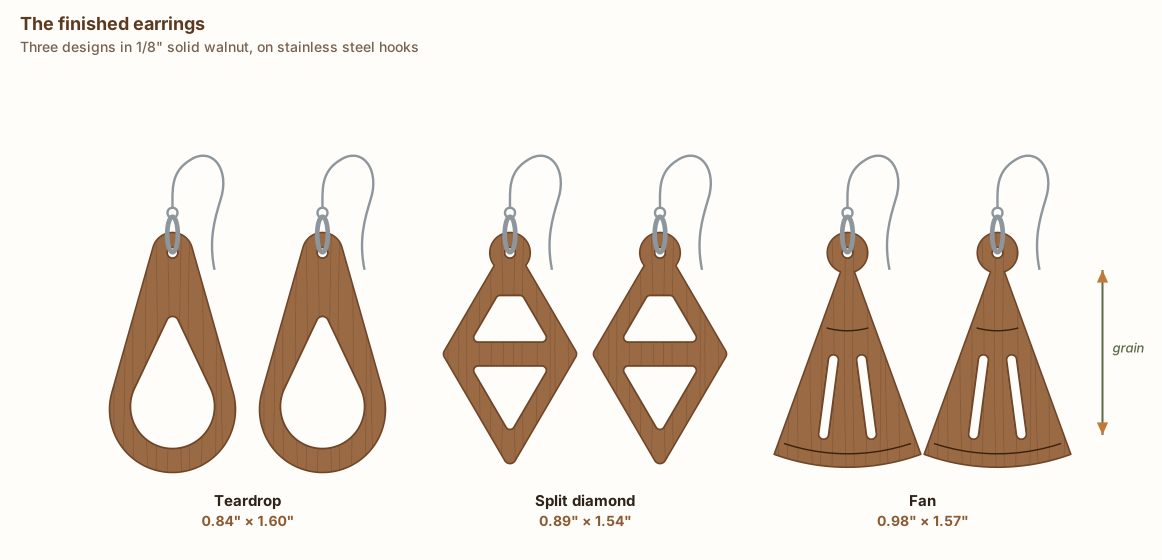
Three pairs of geometric walnut earrings: an open teardrop, a split diamond, and a fan with scored lines. They are cut from thin solid walnut on a diode or CO2 laser and hung on ear hooks.
- Rough size
- About 1 in wide x 1 1/2 in long x 1/8 in thick each
- Wood
- 1/8 in solid walnut
Some states also regulate adult jewelry. California, for example, limits lead in all jewelry and treats stainless or surgical steel, niobium and titanium as lower-risk materials (California Health and Safety Code §25214.2). Buy findings from suppliers that state what they're made of, keep a copy of that listing, and avoid plated or unknown 'base metal' findings. If you sell into the EU or UK, earring parts that go through a pierced ear have a strict nickel-release limit (REACH Annex XVII, entry 27), so either buy findings sold as meeting it or don't ship there.
Describe the metal parts only by what they're made of, as your supplier lists it (for example, 'stainless steel ear hooks'). Don't call them 'hypoallergenic', 'nickel-free' or 'skin-safe' unless your supplier gives you a material spec or test report that backs it up; most stainless steel contains some nickel. Don't call silver-colored findings 'silver' (FTC Jewelry Guides, 16 CFR 23).
Some people react to walnut, and wood dust from sanding is an irritant, so sand with dust collection or a mask. In your listing, name the wood and the finish (for example 'walnut, water-based clear finish') so buyers with sensitivities can decide. Don't call the finish 'non-toxic' or 'skin-safe'; the finish maker doesn't claim that for jewelry.
Don't label them 'Made in USA' unless all or virtually all of the parts, findings included, are made in the US (FTC Made in USA rule). 'Handmade in [your state]' is accurate for the wood work; if you want to mention origin, say the findings are imported if they are.
This build idea is written for making your own; we haven't tested the design, and we don't claim it meets any standard. When you sell a pair, you're treated as its maker, so inspect every earring yourself (no cracks, especially across the grain at the bar and the bottom of the loop) and don't make durability claims you haven't tested. Consider asking an insurance agent about product liability coverage. We haven't load-tested the hanging hole; if a ring pulls through in your test pair, use thicker stock or a slightly bigger wall above the hole.
Laser: never leave it running, keep an extinguisher in reach, and with an open-frame laser everyone in the room wears eyewear rated for its wavelength. See laser and CNC shop safety.
Tools you might use
- Laser
- Hand saw
- Sanding
- Laser cutter/engraver
- Laser software
- Exhaust fan or ducting to the outdoors, or the fume extractor your laser's maker specifies
- Fire extinguisher or a fire blanket, plus a spray bottle of water, within reach
- Laser safety glasses rated for your laser's wavelength
- Digital calipers and a steel rule
- Fine-tooth pull saw and a square, to cut the board into 6" squares
- Painter's tape or hold-downs to keep each square flat
- Sanding block with 220-grit paper, on a flat surface
- Two pairs of flat-nose or chain-nose jewelry pliers
Right tool for the job: Do you need air assist for laser engraving? · What should you put under a laser engraver?
Not sure which laser software to use? Read our free laser software guide.
Not sure how to handle laser smoke? Read our laser fume extraction guide.
Choosing a laser? Read our diode or CO2 laser guide.
Key techniques