
Right tool for the job
Diode or CO2 laser for wood: which kind should you get?
How diode and CO2 lasers differ for wood, and how to choose between them.
Safety first: read the safety notes before you use any of these.

Short answer
Choose by what you'll cut. The independent guides we read agree that a diode laser costs less and suits engraving wood and cutting thin wood, while a CO2 laser cuts thicker material in fewer passes and can cut clear acrylic, which a diode can't. In a 2023 hands-on comparison from Make's German edition, published by heise, a 40-watt diode cut 3 mm plywood as well as the magazine's CO2 laser but couldn't cut 3 mm blue acrylic. Either kind can hurt your eyes: with an open-frame laser, Popular Woodworking says to wear certified glasses that match its wavelength, and to wear them with an enclosed laser too if its lid can be opened during a job.
The short version
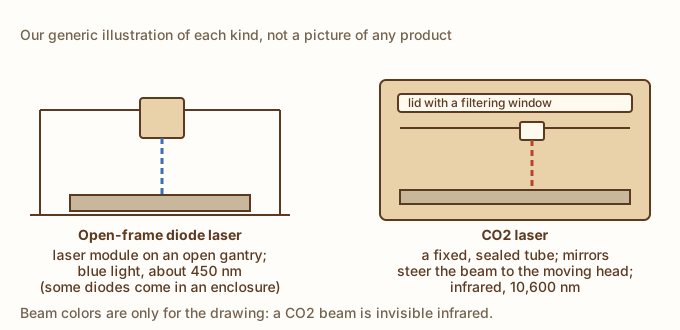
The sources we read line up on the basic split:
- Light. A diode usually shines blue light around 450 nm, though some diode modules are infrared; a CO2 laser’s beam is infrared at 10,600 nm (Popular Woodworking; Make:).
- Materials. Both work wood, leather and paper. Only the CO2 cuts clear acrylic and etches glass (xTool; Make:), and Make: says neither cuts metal.
- Cutting. A CO2 laser cuts thicker material in fewer passes (Make:; Popular Woodworking).
- Cost and size. Diodes cost the least; CO2 machines cost more and take more room (Tom’s Hardware).
One hands-on comparison
Make’s German edition, published by heise, cut the same three projects (in German) on a 40-watt diode and on its own CO2 laser of the same power class in 2023. Both cut 3 mm plywood in one pass at the same speed, and the diode left a cleaner surface, which the tester put down to the CO2’s badly adjusted air assist. Only the CO2 cut the 3 mm blue acrylic; the diode melted and blistered its underside. On 6.5 mm plywood, both left sooty edges. It’s one test of one diode, so treat it as an example, not a rule.
One maker’s numbers, side by side
xTool sells both kinds, so its pages give cutting figures measured the same way (its own lab tests). These are examples, not picks, and other machines differ. Its S1 enclosed diode with the 40-watt module cuts basswood plywood up to 15 mm thick in one pass, and its 55-watt P2S CO2 laser cuts 18 mm basswood and 20 mm clear acrylic in one pass (S1; P2S; checked Oct 15, 2026).
Eye safety: read the class on the label
Under the FDA’s rules, a laser product’s class depends on the highest level of laser radiation you can reach while it runs. So an enclosed machine can be labeled Class 1 with a powerful laser inside, as xTool says the Class 1 version of its P2S is, while an open-frame laser leaves the beam reachable. That rating relies on the enclosure working: the FDA lists a 2024 recall of an enclosed laser whose misplaced interlock let it run with the door open, which could allow Class 4 radiation. The FDA says Class 4 lasers are an immediate eye and skin hazard, even from a reflected beam. Check the class on your machine’s label, and read our Laser and CNC Shop Safety and Shop Safety Essentials tips.
For our laser build ideas
Several of our laser build ideas work on either kind of laser. The Christmas village cuts 1/8” plywood on either kind, and the coaster set and the keepsake box lid work on either. For testing engrave, score and cut settings on thin-wood ornaments with either kind, see laser engraving wood ornaments.
Your options
Open-frame diode laser
A small laser module that shines blue light (about 450 nm, per Popular Woodworking, Make: and xTool) and moves on an open gantry over the work, with no cabinet around it.
Good for: Engraving wood, leather and other organic materials, and cutting thin wood (Popular Woodworking; xTool). The open frame can sit over pieces too big for a cabinet (Tom's Hardware).
- Nothing contains the beam or the smoke. Popular Woodworking says eye protection and exhaust come first with these machines, and Tom's Hardware suggests adding an enclosure if the laser doesn't come with one.
- Can't cut clear acrylic or work glass: Tom's Hardware says clear and blue acrylic are invisible to a diode's blue light, xTool says diodes struggle with transparent materials, and CNCSourced's settings table lists no diode setting for clear acrylic. In the 2023 comparison from Make's German edition, a 40-watt diode couldn't cut 3 mm blue acrylic.
- Make: (2023) warns that some cheap diode lasers are advertised by the whole machine's power draw rather than the laser's output, so a "150W" machine may have under 10 watts of laser output.
- Open-frame diodes usually need assembling, unlike most enclosed and CO2 machines (Popular Woodworking).
Budget: Popular Woodworking, Make: and Tom's Hardware all call diodes usually the lowest-priced kind. Check current prices on the maker's own store.
Enclosed diode laser
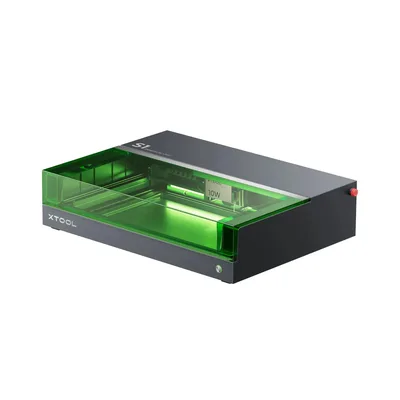
The same kind of blue diode laser inside a cabinet with a tinted, filtering lid and an exhaust fan.
Good for: Diode work where you want the beam and smoke contained, such as indoors (Popular Woodworking; Tom's Hardware).
- Popular Woodworking says enclosed lasers have tinted windows that block the beam and lock-out covers that keep them from being opened during use, and that you still need certified glasses if the lid can be opened mid-job.
- Work size is limited by the cabinet; Tom's Hardware suggests checking for a pass-through door if you work on oversized pieces.
- For example (from the maker; an example, not a pick): xTool says its S1 with the 40-watt diode module cuts basswood plywood up to 15 mm thick in one pass in its own lab tests, and its store listed the 40W Basic Bundle at $1,699 (checked Oct 15, 2026).
Budget: Check current prices on the maker's own store; see the maker example above.
CO2 laser
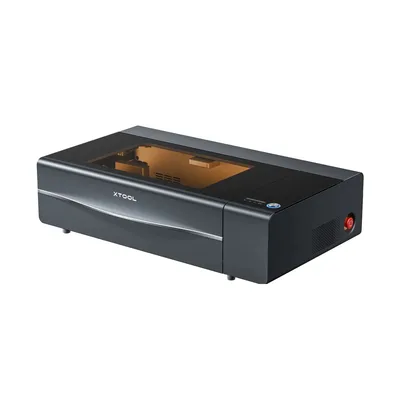
A laser whose beam comes from a sealed glass tube of carbon dioxide gas. The tube stays put and mirrors steer the beam to the moving head (Popular Woodworking). The beam is infrared, at 10,600 nm (Popular Woodworking; Make:; OSHA), and the machine is usually a large enclosed box (Make:).
Good for: Cutting thicker wood in fewer passes, cutting acrylic of any color including clear, and etching glass (Popular Woodworking; Make:; Tom's Hardware; xTool).
- Bigger, heavier and more expensive: Popular Woodworking's author says his CO2 machine weighs over 100 pounds, and Tom's Hardware says CO2 machines' price and size suit businesses or hobbyists with a large budget.
- Can't engrave bare metal (Make:; xTool).
- Popular Woodworking says CO2 lasers are usually Class 4, the most hazardous class, though an enclosed machine can carry a lower class on its label (FDA; xTool).
- In the 2023 comparison from Make's German edition, the magazine's CO2 laser left more scorch marks on 3 mm plywood than the 40-watt diode, which the tester put down to its badly adjusted air assist, not to CO2 lasers as such.
- For example (from the maker; an example, not a pick): xTool says its 55-watt P2S cuts 18 mm basswood and 20 mm clear acrylic in one pass and sells it in Class 4 and Class 1 versions; its store listed the P2S on its own at $2,999 as a pre-order (checked Oct 15, 2026).
Budget: Popular Woodworking, Make: and Tom's Hardware all put CO2 lasers above diodes in price. Check current prices on the maker's own store.
What we'd start with
A diode laser in an enclosure, built in or added. Diodes are usually the lowest-priced kind and suit engraving and thin cuts (Popular Woodworking; Make:), and Tom's Hardware suggests adding an enclosure to any laser that doesn't come with one.
An open-frame diode, if you need to work on pieces too big for a cabinet. Tom's Hardware notes an open frame can sit over large pieces. Popular Woodworking says you then need certified glasses matched to its wavelength, and a way to exhaust the smoke.
A CO2 laser, if you cut thick wood or clear acrylic often. The guides we read agree it cuts thicker material in fewer passes and handles clear acrylic, which a diode can't (Popular Woodworking; Make:; Tom's Hardware), but it costs more and needs more room.
See CO2 laser
Product images are from each maker’s product pages and are shown only to identify the products. The makers haven’t reviewed, sponsored or endorsed this page. If you own an image here and want it removed, email hello@sawdustsmart.com.
Photo credits
- xTool S1: Image: xTool product image
- xTool P2S: Image: xTool product image
Sources
- Popular Woodworking: Laser engravers for the woodshop (external site, opens in a new tab) (independent guide, June 22, 2026; checked October 15, 2026): A woodworking magazine's overview by A.J. Hamler, who uses his own CO2, fiber and diode lasers. It compares diode and CO2 lasers on materials, power, cutting depth, price and size, and covers eyewear, enclosures, fire and ventilation. The page says the publisher may earn a commission from affiliate links; we found none in the article itself.
- Make:: Which laser should you buy? (external site, opens in a new tab) (independent guide, May 10, 2023; checked October 15, 2026): A buying guide by Caleb Kraft from Make: magazine (Vol. 84) comparing diode, CO2 and fiber lasers on price, speed, work area and materials, with a warning about diodes advertised by power draw instead of laser output. It names an xTool and an Atomstack diode among its examples. The site says it may earn an affiliate commission (network not stated), and its Maker Shed store sells xTool lasers; we found no affiliate links in the article text.
- Tom's Hardware: Laser cutters and engravers buying guide (2026) (external site, opens in a new tab) (independent guide, October 27, 2024; updated September 8, 2026; checked October 15, 2026): A buying guide built on the outlet's own laser reviews; we use only its shopping tips on diode vs. CO2, enclosures and work size, not its rankings. The page has Amazon Associates links and Impact affiliate links to Best Buy and xTool, and xTool machines are among its ranked picks.
- CNCSourced: How to laser cut plywood (external site, opens in a new tab) (independent guide, July 30, 2023; updated January 3, 2024; checked October 15, 2026): A plywood-cutting guide by Leo Watts with settings for diode and CO2 lasers; its settings table lists no diode setting for clear acrylic. We don't use its cutting depths (those come from the maker). The site has Amazon Associates links and an xTool referral link, and the author cuts with his own xTool diode, so xTool is featured.
- Make (German edition, published by heise): CO2 vs. diode laser, who cuts better? (in German) (external site, opens in a new tab) (independent test, November 18, 2023; checked October 15, 2026): A hands-on comparison by Johannes Börnsen of a 40-watt Creality Falcon 2 diode against the magazine's own CO2 laser of the same power class, on three projects. Both cut 3 mm plywood in one pass, the CO2 with more scorching, which he blames on its air assist; only the CO2 cut 3 mm blue acrylic; both left sooty edges on 6.5 mm plywood. The companion video's description has a Creality store link with an affiliate code for the tested diode, and Amazon Associates links.
- xTool: Fiber vs. CO2 vs. diode laser (maker's guide) (external site, opens in a new tab) (maker spec page, April 8, 2023; updated July 27, 2026; checked October 15, 2026): A maker that sells both kinds: diode lasers (450 nm) work organic materials and some opaque acrylic but not glass or transparent materials; CO2 lasers (10.6 micrometers) work a wider range of non-metals, including acrylic and glass, but can't engrave uncoated metal.
- xTool S1 enclosed diode laser (maker's page) (external site, opens in a new tab) (maker spec page, no date shown; checked October 15, 2026): Lists one-pass cutting thicknesses from xTool's own lab tests (basswood plywood up to 15 mm with the 40-watt module, 10 mm with 20 watts), a light-filtering lid and exhaust fans. Its store listed the 40W Basic Bundle at $1,699; the 20W bundles showed as unavailable.
- xTool P2S 55W CO2 laser (maker's page) (external site, opens in a new tab) (maker spec page, no date shown; checked October 15, 2026): Says it cuts 18 mm basswood and 20 mm clear acrylic in one pass, comes in Class 4 and Class 1 versions, and has a built-in exhaust fan. Its store listed the P2S on its own at $2,999, as a pre-order.
- FDA: Laser products and instruments (external site, opens in a new tab) (safety authority, content current as of November 13, 2024; checked October 15, 2026): The US regulator's hazard classes: Class 1 is considered non-hazardous, and Class 4 is an immediate eye and skin hazard from the direct or reflected beam and may be a fire hazard. Labels for Classes 2 to 4 must state the class.
- eCFR: 21 CFR 1040.10, laser products (external site, opens in a new tab) (safety authority, no date shown (current regulation); checked October 15, 2026): The federal rule: a laser product's class depends on the highest laser radiation a person can reach while it runs, so a closed housing that blocks the beam can put a powerful laser in a lower class.
- OSHA Technical Manual: Laser hazards (external site, opens in a new tab) (safety authority, no date shown; checked October 15, 2026): OSHA's construction-industry rule for workers exposed to laser beams calls for goggles that protect for the laser's specific wavelength with an adequate optical density, and the manual notes that CO2 lasers emit in the far infrared at 10.6 micrometers.
- MIT EHS: Laser cutter safety (external site, opens in a new tab) (safety authority, no date shown; checked October 15, 2026): A university safety office's rules: follow the maker's instructions, never leave a running laser cutter unattended, keep a fire extinguisher nearby, and don't cut PVC, which gives off an extremely dangerous gas.
- xTool: Laser safety (external site, opens in a new tab) (maker spec page, no date shown; checked October 15, 2026): A laser maker's safety page: read the safety instructions fully and follow the machine's limits, and never leave a laser running unattended because of the fire risk.
- UK Office for Product Safety and Standards: Falcon2 engraving machine report (external site, opens in a new tab) (safety authority, August 9, 2024; checked October 15, 2026): The UK regulator found a serious risk to sight from a 22-watt Class 4 self-assembly diode engraver sold as the Creality Falcon2 for consumer use, said the goggles supplied with it didn't give the required protection, and rejected the import at the border. It is not the 40-watt Falcon 2 that Make's German edition tested; we found no report on that unit.
- FDA recall Z-0524-2025: enclosed laser engraver interlock (external site, opens in a new tab) (safety authority, posted December 3, 2024; checked October 15, 2026): An open FDA recall of the Epilog Fusion Pro 24, an enclosed laser: a misplaced interlock let some units run with the front door open, which can allow Class 4 laser radiation, so the machine didn't meet its lower-class rating. The maker offers a free repair kit.
How we picked
We didn't hands-on test these. We read independent guides (Popular Woodworking, Make:, Tom's Hardware, CNCSourced) and an independent hands-on comparison of a diode and a CO2 laser (from Make's German edition, published by heise), plus makers' pages (xTool, which sells both kinds), laser-safety guidance, rules and recall notices from government and university safety offices (the FDA, OSHA, the UK's Office for Product Safety and Standards, MIT EHS) and xTool's safety page. Every claim on this page comes from a source linked under Sources. This is a comparison of two kinds of laser, so it has no product picks: we would only name a product as a pick with at least three independent sources from at least two different outlets, each naming that exact model, including at least one independent test or review, plus the maker's own page. Cutting depths and prices come only from the maker's own pages, with the date we checked; the two xTool machines named on this page are examples of each kind from one maker that sells both, not picks. The page's own claims rest on five independent sources from four outlets (we count Make: and its German edition as one). Links were last checked on .
No paid links. Every link on this page is a plain link: no affiliate codes or tracking, and no company paid or asked to be listed (disclosure). Links open in a new tab.
Some outlets we cite get review samples from tool makers; we don't use pieces a maker paid for or sponsored.
We pick tools from independent tests and reviews, not our own testing.