
Technique
How to Cut Curves and Inside Cutouts in Wood
Cut smooth curves and closed inside shapes with a scroll saw, jigsaw, bandsaw or coping saw: pick the saw for the curve, drill blade-entry holes, use relief cuts, and clean up to the line.
Made in my shop
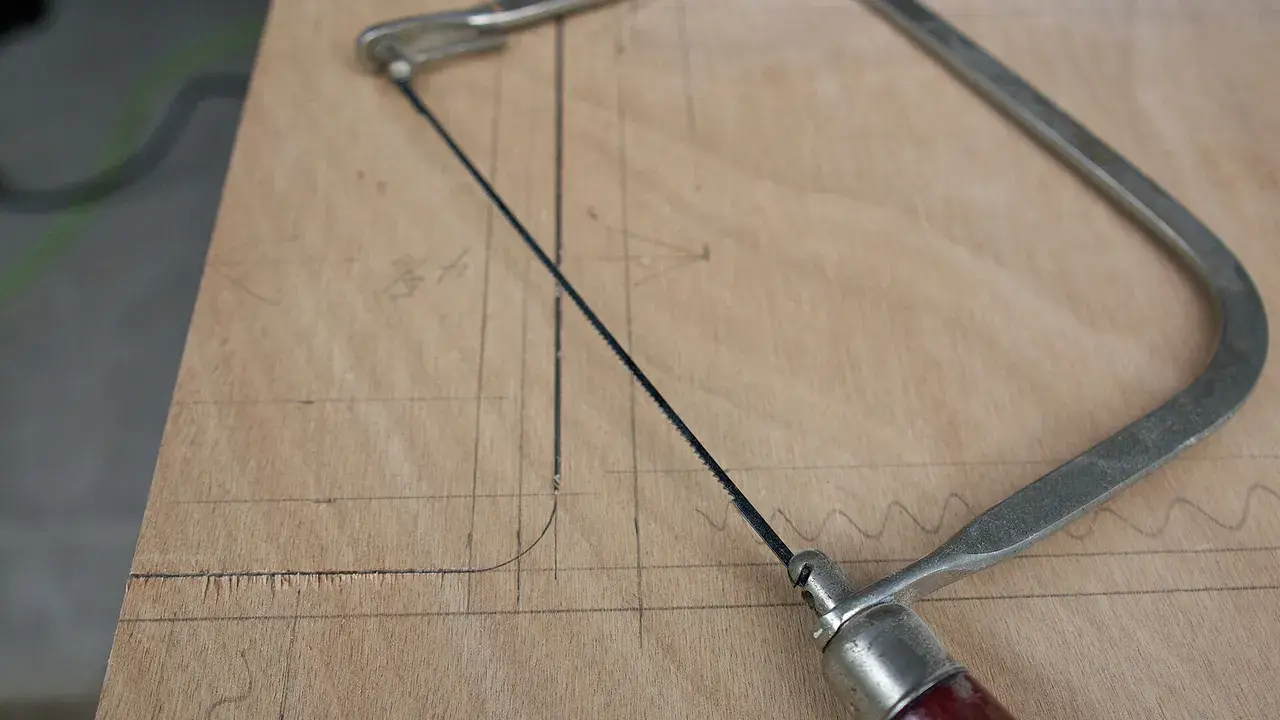
A lot of holiday pieces are mostly curves: leaf outlines, tree and star profiles, sled runners, the open center of a wreath. The saws differ, but the method is the same. Mark a clean line, cut on the waste side of it, give the blade room to turn, and sand or file the last bit back to the line. If you’re cutting many copies of one shape, start with a template (see templates for repeat shapes).
Match the saw to the curve
- Scroll saw: the thin blade turns tight curves and fine detail, and it’s the saw for small interior cutouts like windows in a gingerbread silhouette or vein lines in a leaf. Its reach is limited by the throat, so it suits small and medium pieces.
- Jigsaw: goes to the work, so it handles big parts and inside cutouts in plywood, like the center of a scrap wood wreath. Slow it down and turn off the orbital action for cleaner cuts on curves (see our jigsaw picks).
- Bandsaw: fast and steady on outside curves in thicker stock. It can’t start inside a closed shape without cutting in from the edge.
- Coping saw: a hand option for small curves and inside cuts. The blade comes off the frame, so you can thread it through a hole.
Narrower blades turn tighter curves; wider blades track straighter on gentle ones.
Mark the line so you can see it
Draw the shape with a sharp pencil or trace a template, and shade the waste side so you never lose track of which side to cut on. Measuring and marking accurately covers thin, crisp lines. On dark woods like walnut, a light pencil or a strip of painter’s tape under the line helps the line show.
Inside cutouts: drill a blade-entry hole
For a closed shape, drill a hole in the waste near the line, a little bigger than the blade is wide. On a scroll saw or coping saw, release the blade, thread it through the hole, and re-tension it. On a jigsaw, drop the blade into the hole and start cutting from there. At a sharp inside corner, drill a hole right at the corner so the blade can turn there instead of forcing it.
Relief cuts and turning
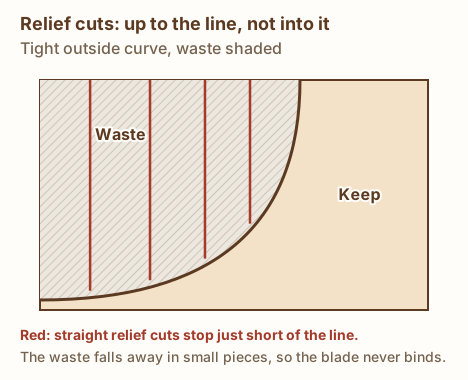
- Relief cuts: on a tight outside curve, make straight cuts from the edge of the waste up to, but not into, the line. As you cut along the curve, the waste falls away in small pieces, so the blade never binds.
- Turn the work, not the blade: feed slowly and steer the piece so the blade stays on the line; don’t twist it sideways. On a scroll saw, turn the work smoothly as you feed it.
- Let the blade cut: pushing hard bends the blade and leaves a beveled or wavy edge. If the cut wanders, back up a little and come at the line again.
- Cut in from the easy side: where two curves meet in a point, like the tip of a leaf lobe, come in from each side toward the point rather than trying to turn around it.
Keep your fingers to the sides of the blade, never in its path, and let it stop before you clear offcuts.
Swipe sideways to see the whole diagram, or tap it to open full size.
Clean up to the line
Stopping just outside the line leaves a little to remove. Clean up outside curves with a sanding block, a spindle or drum sander, or a rasp, and inside curves with half-round files or sandpaper wrapped around a dowel. Work with the grain where you can and keep the edge square to the face. Then sand the faces through the grits in our sanding progression.
Where to use it
- Scrap wood wreath: a jigsaw for the ring and its open center.
- Wooden fall leaf wall hanging: a scroll saw for lobes and vein cutouts.
- Gingerbread house porch silhouette: a jigsaw for the outline, blade-entry holes for the door and windows.
- DIY wooden sled ornaments: small curved runners on a scroll saw or with a coping saw.
Choosing a sander? Read our sander for cutting boards guide.
Get new build ideas by email
Free build ideas and tips by email, about twice a month. We'll send a link to confirm. Our emails are sent by Kit, which tracks opens and clicks so we can see what's useful. Unsubscribe anytime. You must be 16 or older. Privacy policy.