
Right tool for the job
Which CNC router bits should you buy first?
Which bits to get first for a hobby CNC router, and why.
Safety first: read the safety notes before you use any of these.
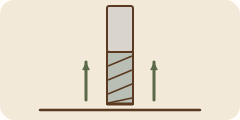
Short answer
Start with a 1/4" flat end mill, the bit most of our CNC build ideas call for. CNCRouterInfo calls a 2-flute upcut the standard bit for most hobby work: it clears chips well but can leave a rough top edge. Then add bits for the jobs you do: a downcut for clean top edges in solid wood (Popular Woodworking's go-to for hardwood parts), a compression bit for cutting through plywood cleanly on both faces (Woodsmith's CNC Basecamp; Popular Woodworking), a V-bit for signs, and a surfacing bit to flatten your spoilboard (Sienci Labs; CNCRouterInfo).
Why a 1/4” flat end mill first
Our phone and tablet stand and V-carved name sign both cut with a 1/4” flat end mill. The cribbage board uses a 1/8” upcut end mill for its peg holes. CNCRouterInfo calls a 2-flute upcut the standard bit for most hobby work. It pulls chips out of the cut, but it can leave a fuzzy top edge.
Upcut, downcut or compression?
The flute direction decides which face comes out clean. Woodsmith’s CNC Basecamp compared them on plywood: an upcut clears chips fast but chips the top veneer, a downcut leaves a clean top but packs chips into the cut, and a compression bit leaves both faces clean once the cut goes past its short upcut section. Popular Woodworking (2017) gives the same advice for plywood and adds that its author reaches for a downcut for hardwood parts.

Signs and the spoilboard
For V-carved signs, see our V-bit guide: the angle decides how deep each letter goes. A surfacing bit is for the board under your work, not the work itself: Sienci Labs explains that surfacing makes the spoilboard parallel to the machine, so a cut set to a given depth comes out that deep everywhere.
Budget or premium?
Andy Bird Builds (YouTube, 2025) ran ten budget and premium 1/4” downcut bits through the same tests, which he calls not very scientific. The pricier bits generally did better, but he says the test reminded him that most bits break from setup errors, so he suggests learning on a cheap bit and saving premium bits for finished pieces. The video description has his own affiliate links, including to some of the bit makers. It opens on youtube.com, which uses its own cookies.
Your options

1/4" flat end mill (upcut)
A spiral bit with a flat bottom whose flutes lift chips up and out of the cut. Our phone stand and name sign build ideas both call for a 1/4" flat end mill.
Good for: Profiles, pockets, MDF and general cutting.
- Clears chips well, so it suits pockets and deep cuts (CNCRouterInfo); Woodsmith's CNC Basecamp calls it the fast choice for that reason.
- Can tear or fuzz the top edge, and chip plywood's top veneer (CNCRouterInfo; Woodsmith's CNC Basecamp).
- Popular Woodworking's author uses upcut bits for fast material removal, MDF and general use.
Budget: We don't quote a price. Popular Woodworking says carbide or carbide-coated bits last longer and handle heat better, so they're the first choice.
Downcut end mill
A spiral bit whose flutes push chips down into the cut, pressing the top fibers flat.
Good for: Clean top edges in solid wood, veneered plywood and shallow pockets.
- Leaves a clean top edge (CNCRouterInfo; Woodsmith's CNC Basecamp). Popular Woodworking's author calls it his go-to for hardwood furniture parts, and says it helps hold the part steady.
- Chips pack into the cut, so it needs shallower passes and attention to chip clearing and burning (Popular Woodworking; Woodsmith's CNC Basecamp; CNCRouterInfo).
- The bottom face comes out a little rougher (Woodsmith's CNC Basecamp).
Budget: We don't quote a price. CNCRouterInfo says downcuts cost more than upcuts.
Compression bit
A spiral bit with upcut flutes at the tip and downcut flutes above them, so it presses both faces inward.
Good for: Cutting plywood and other sheet goods all the way through.
- Clean top and bottom faces on through-cuts in plywood (Popular Woodworking; Woodsmith's CNC Basecamp; CNCRouterInfo).
- The first pass must go deeper than the upcut section, or it acts like an upcut and can tear the top (Woodsmith's CNC Basecamp; Popular Woodworking; CNCRouterInfo). Check the bit's stated upcut length.
- Not for shallow pockets or surface carving (CNCRouterInfo).
Budget: We don't quote a price. CNCRouterInfo says it costs more than an upcut or downcut alone.
V-bit
A cone-shaped bit for V-carved lettering, signs and chamfers.
Good for: Signs and lettering, such as our V-carved name sign.
- The angle sets how deep each letter goes; see our V-bit guide for 90° versus 60° (Woodsmith's CNC Basecamp; CNCRouterInfo).
Budget: We don't quote a price.
Spoilboard surfacing bit
A large-diameter, flat-bottomed cutter for skimming the spoilboard (wasteboard) under your work.
Good for: Flattening the spoilboard so it's parallel to the machine's movement.
- Sienci Labs says a purpose-made surfacing bit is larger, covers the area quickly and leaves a good finish; a 1/4" bit works but takes much longer.
- CNCRouterInfo says to pick a diameter and shank your router and machine can handle, and not to use a ball-nose bit, which leaves a wavy surface.
Budget: We don't quote a price.
What we'd start with
A 1/4" flat end mill, the size most of our CNC build ideas call for; a 2-flute upcut is the usual type. CNCRouterInfo names a 2-flute upcut as the standard bit for most hobby work, and it clears chips well in pockets and deep cuts. Expect a rougher top edge; CNCRouterInfo says that's fine if you'll sand or paint anyway.
Add a downcut or a compression bit, and a V-bit. A downcut for clean top edges in solid wood, a compression bit for clean plywood through-cuts (Popular Woodworking; Woodsmith's CNC Basecamp), and a V-bit for signs.
See Compression bit
Add a dedicated surfacing bit for the spoilboard. CNCRouterInfo calls surfacing the spoilboard the first job on a new machine. Sienci Labs notes a 1/4" bit can do it, just much more slowly, and both recommend a purpose-made, flat-bottomed surfacing cutter.
Sources
- Popular Woodworking: CNC tooling basics, mills and bits for cutting wood parts (Tim Celeski) (external site, opens in a new tab) (independent guide, May 13, 2017; updated June 21, 2018; checked October 15, 2026): From 2017: explains upcut, downcut and compression end mills, and says carbide or carbide-coated bits are the first choice. The author uses upcuts for fast removal and MDF, downcuts as his go-to for hardwood parts (with shallower passes because chips pack in), and compression bits for plywood, with a first pass just past the upcut section. The page carries the publisher's note that it may earn a commission from affiliate links.
- Woodsmith CNC Basecamp: Episode 1, smooth CNC cuts in plywood (external site, opens in a new tab) (independent guide, November 3, 2021; checked October 15, 2026): Compares straight, upcut, downcut and compression bits for plywood: upcuts clear chips fast but chip the top veneer, downcuts give clean tops but need care with chip clearing and burning, and compression bits give clean faces on both sides once the cut goes past their upcut section. The page carries the publisher's own commission-earning product links.
- CNCRouterInfo: Upcut vs downcut vs compression end mills (external site, opens in a new tab) (independent guide, updated October 2026; checked October 15, 2026): Explains when to use each: upcut for pockets, deep cuts and MDF (the standard bit for most hobbyists), downcut for clean top surfaces, compression for plywood through-cuts, but only once the first pass reaches past the upcut tip. The site uses Amazon and AliExpress affiliate links.
- CNCRouterInfo: CNC wasteboard guide (external site, opens in a new tab) (independent guide, updated October 2026; checked October 15, 2026): Calls surfacing the spoilboard the first job on a new machine. Recommends a flat-bottomed carbide spoilboard cutter sized for the router and machine, run within the maker's RPM range, and warns that a ball-nose bit leaves a wavy surface. The site uses Amazon and AliExpress affiliate links.
- Andy Bird Builds (YouTube): I tested 10 popular CNC router bits to find the best value (external site, opens in a new tab) (independent test, October 26, 2025; checked October 15, 2026): An independent hands-on comparison of ten budget and premium 1/4" downcut bits run through the same cutting and endurance tests; the video says it isn't sponsored, and the creator calls the test not very scientific. The pricier bits generally did better. He says it reminded him that most bits break from setup errors rather than speeds and feeds, so he suggests learning on a cheap bit and saving premium bits for finished work. The video description carries the creator's own affiliate and referral links, including one to IDC Woodcraft, whose bit came out on top; we don't use his ranking. It opens on youtube.com, which uses its own cookies.
- Sienci Labs: Surfacing the wasteboard (LongMill) (external site, opens in a new tab) (maker spec page, April 30, 2021; updated December 18, 2025; checked October 15, 2026): A CNC maker's guide: surfacing makes the wasteboard parallel to the machine. Sienci sells surfacing bits in its own store. A purpose-made surfacing bit is larger and covers the area quickly with a good finish, while a 1/4" bit works but takes much longer.
- Sienci Labs: Mill One safety manual (external site, opens in a new tab) (maker spec page, November 18, 2025; checked October 15, 2026): A CNC maker's safety manual: secure the work with clamps, never by hand; bits are sharp and can crack and break without notice, so handle them carefully and check them for damage before running the machine.
- Sienci Labs: CNC safety fundamentals (external site, opens in a new tab) (maker spec page, January 20, 2026; checked October 15, 2026): A CNC maker's safety page: hearing and eye protection, a dust mask or respirator of at least N95, never leaving the machine unattended, keeping hands off the machine while it runs, and a warning that materials can ignite during cutting or in dust collection bins.
- Carbide 3D: Machine safety (external site, opens in a new tab) (maker spec page, no date shown; checked October 15, 2026): A CNC maker's safety page: wear impact-resistant eye protection, hearing protection and a mask suited to the dust; never reach into the working area while it runs; handle end mills with care; never leave the machine running unattended.
- Carbide 3D: Shapeoko HDM 3.0 manual (external site, opens in a new tab) (maker spec page, no date shown; checked October 15, 2026): A CNC maker's manual: engage the spindle lock-out before tool changes and turn off the power before adjusting; inspect end mills before each use (sharp, not chipped) and make sure the collet holds them securely; secure the workpiece; the e-stop cuts the machine's power; consider fire from friction and keep an extinguisher handy; sawdust can combust spontaneously.
- Carbide 3D: ER collet basics (external site, opens in a new tab) (maker spec page, no date shown; checked October 15, 2026): A CNC maker's guide to collets: snap the collet into its nut before inserting the bit, and periodically wipe dust off the collet and spindle taper, because dust throws off accuracy.
- Whiteside: 90° V-groove bit 1502 (external site, opens in a new tab) (maker spec page, no date shown; checked October 15, 2026): A bit maker's spec page, used here as an example of a bit maker's specs: this bit's page lists its shank and collet size, a recommended speed range (16,000–20,000 RPM) and a maximum (24,000 RPM).
How we picked
We didn't hands-on test these. We read independent guides (Popular Woodworking, Woodsmith's CNC Basecamp, CNCRouterInfo) and an independent hands-on comparison of ten 1/4" bits (Andy Bird Builds on YouTube), plus bit and machine makers' spec and safety pages (Carbide 3D, Sienci Labs, Whiteside). Every claim on this page comes from a source linked under Sources. We only name a product when it has at least three independent sources from at least two different outlets, each naming that exact product, including at least one independent test or review, plus the maker's spec page. No bit met that bar: the one hands-on comparison we found is a single outlet. So this guide recommends kinds of bit, not products. The page's own claims rest on at least three independent sources from at least two outlets. Links were last checked on .
No paid links. Every link on this page is a plain link: no affiliate codes or tracking, and no company paid or asked to be listed (disclosure). Links open in a new tab.
Some outlets we cite get review samples from tool makers; we don't use pieces a maker paid for or sponsored.
We pick tools from independent tests and reviews, not our own testing.