
Shop tip
Finishes for Cutting Boards: What the Labels Say
Mineral oil, board butters, wax, pure tung oil, and bowl finish compared using each maker's own label: what's in it, how to apply it, how long it takes to cure, and how to get rid of the oily rags without starting a fire.
Made in my shop
- Reading time
- About 7 min
Swipe sideways to see the whole diagram, or tap it to open full size.
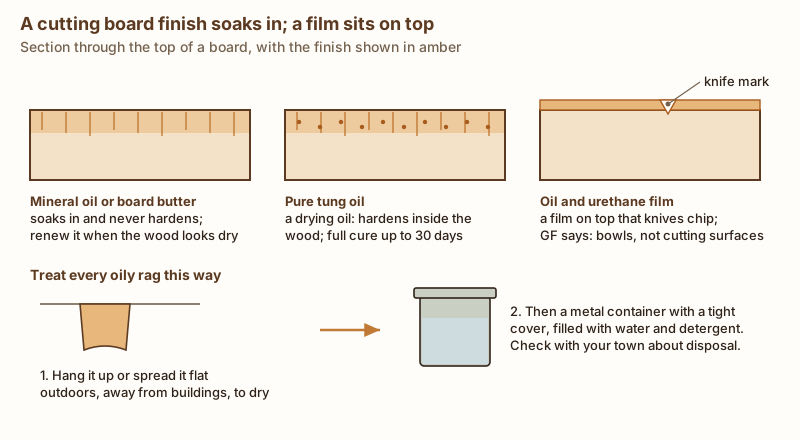
A cutting board finish has a different job from a furniture finish. It gets cut, washed, and dried over and over, so most people use a finish that soaks in and is easy to renew, not a hard film that knives will chip. This guide compares the common choices using what each maker says on its own product page. We haven’t lab-tested any of them, and we don’t make health or safety claims about any finish. Read the label of the exact product you buy, and follow it.
A note on wording. Makers describe their products in different ways: some say the oil meets specific FDA regulations for food contact, some cite an NSF certification, and some say the finish is suitable for food contact once fully cured. Those are the makers’ statements about their own products. If you sell boards, quote the label of the finish you used rather than making your own claim, and in listings, don’t describe a board as safe for food or approved by the FDA. See our pricing guide and selling disclaimer.
Quick comparison
| Finish | Example product | What it is | Maker’s application and cure directions |
|---|---|---|---|
| Mineral oil | Howard Cutting Board Oil | Mineral oil only | At least 2 coats on new boards; 3–4 coats on thick blocks, each soaking in at least an hour; wipe off the excess |
| Oil and wax “board butter” | Howard Butcher Block Conditioner | Mineral oil, beeswax, carnauba wax | Let stand at least 1 hour, or overnight if possible; 3–4 coats on unconditioned surfaces 1.5” thick and over; wipe off the excess |
| Oil and wax blend | Walrus Oil Cutting Board Oil | Beeswax, fractionated coconut oil, mineral oil, vitamin E | Let it set 6–12 hours, then buff off the excess; reapply every 1–2 months on heavily used boards |
| Wax only | Walrus Oil Wood Wax for Cutting Boards | Beeswax, fractionated coconut oil, vitamin E | Let it set 15 minutes, then buff; reapply every 1–2 months on heavily used boards |
| Pure tung oil | RMP Finishes Pure Tung Oil | Tung oil only, a drying oil that hardens as it cures | 3–5 coats; feels dry in 2–4 days, partial cure around day 10, full cure up to 30 days |
| Oil and urethane film | General Finishes Wood Bowl Finish (formerly Salad Bowl Finish) | Oil-based urethane | Recoat after 24+ hours; light use 7–10 days; cure 30 days. GF says it’s for decorative bowls and turnings, not cutting surfaces |
Mineral oil
Plain mineral oil is the classic starting point. It soaks in, darkens the wood slightly, and never hardens, so you renew it whenever the board looks dry.
- What the maker says: Howard describes its Cutting Board Oil as “100% Pure USP Food Grade Mineral Oil” that is “tasteless, odorless, colorless, and will never go rancid.” Howard says the oil meets the requirements of FDA regulations for direct and indirect food contact, and cites 21 CFR 172.878 and 21 CFR 178.3620(a). Howard also says the oil has no contact with nuts, gluten, or other potentially allergenic materials in production, storage, or transport.
- How Howard says to apply it: wipe it on with a clean soft cloth. Apply at least 2 coats to new or raw boards; for thick surfaces like butcher blocks, apply 3–4 coats and let each soak in for at least an hour. Wipe away the excess before use.
- Cure time: mineral oil doesn’t cure. Once the excess is wiped off and the surface isn’t oily to the touch, it’s done. Howard recommends following up with its Butcher Block Conditioner or wax for more protection.
- Buy the right bottle. Look for a label that says it’s for food contact, like Howard’s. Don’t use a hardware-store oil, a “furniture oil,” or a “Danish oil” unless its label specifically says it’s meant for food-contact surfaces.
Oil and wax: “board butter” and blends
Adding wax to the oil gives a slightly more water-resistant surface with a soft sheen.
Howard Butcher Block Conditioner. Howard calls it “a combination of pure USP grade mineral oil, beeswax, and carnauba wax,” and says the mineral oil in it “exceeds U.S. FDA regulations for direct and indirect contact with food.” Howard’s directions: shake gently, apply with a clean soft cloth, and let it stand “at least 1 hour or if possible, overnight.” For unconditioned surfaces 1.5” thick and over, apply 3–4 coats, on all sides. Wipe off the excess, and reapply “whenever the wood looks or feels dry.”
Walrus Oil Cutting Board Oil. Walrus Oil lists the ingredients as beeswax, fractionated coconut oil, pure mineral oil, and vitamin E, and describes the product as NSF certified for food-contact surfaces. Its directions: sand an unfinished board to 220–400 grit (or clean and dry a used board), shake well, apply, let it set for 6–12 hours, then buff away the excess. Reapply every 1–2 months for heavily used boards. Walrus Oil lists it as “non-polymerizing,” meaning it doesn’t harden like a drying oil.
Walrus Oil Wood Wax for Cutting Boards. A wax-only option: Walrus Oil lists beeswax, fractionated coconut oil, and vitamin E, and describes it as NSF certified for food-contact surfaces. Apply it with a non-woven pad or rag, let it set for 15 minutes, then buff away the excess. Walrus Oil says it can be used alone or over a coat of its Cutting Board Oil. Reapply every 1–2 months for heavily used boards.
If allergies matter to you or the person you’re giving a board to, read the full ingredient list: these products contain beeswax, and the Walrus Oil products list coconut oil.
Pure tung oil
Pure tung oil is a drying oil: it reacts with air and hardens inside the wood. It’s more water-resistant than mineral oil once cured, but it takes weeks to get there.
- Read the label carefully. Many products sold as “tung oil finish” are blends with solvents and other ingredients. Pure tung oil lists one ingredient.
- What the maker says: RMP Finishes (The Real Milk Paint Co.) describes its Pure Tung Oil as “100% natural tung oil—single-ingredient, cold-pressed,” and says that once fully cured it is suitable for food-contact surfaces such as cutting boards.
- How RMP says to apply it: apply thin coats, let each absorb, and wipe off the excess. RMP suggests 3–5 coats for everyday use. Work between 65 and 85°F with good ventilation, out of direct sunlight.
- Cure time: RMP says it may feel dry within 2–4 days, reaches partial cure around day 10, and takes up to 30 days for a full cure. Watch for oil seeping back to the surface over the first week, and wipe it off before it hardens into sticky spots.
- Plan for it. If you’re making boards as gifts, a tung oil finish needs to be finished about a month before the board goes into use.
Oil and urethane film finishes
General Finishes Wood Bowl Finish (formerly called Salad Bowl Finish) is a film finish of oil and urethane. GF describes it as “designed for decorative wooden bowls and turnings” and says that for countertops actively used for chopping and cutting, you should use its Butcher Block Oil instead. GF lists a recoat time of 24+ hours, light use after 7–10 days, and a full cure at 30 days. It’s a reasonable choice for serving boards and bowls that won’t be cut on, following GF’s directions; for the cutting face of a board, choose a penetrating oil or wax.
Caring for an oiled board
Hand-wash the board, dry it standing on edge, and never soak it or put it in the dishwasher. Re-oil when the wood looks pale or dry. That’s what both Howard (“whenever the wood looks or feels dry”) and Walrus Oil (every 1–2 months for heavily used boards) tell you to do.
Oily rags can self-heat and catch fire: dry them flat outdoors, then store them in a sealed metal can of water.
Sources
- Howard Products — Cutting Board Oil (ingredients, FDA regulation citations, directions)
- Howard Products — Butcher Block Conditioner (ingredients, directions, reapplication)
- Walrus Oil — Cutting Board Oil (ingredients, NSF certification, directions)
- Walrus Oil — Wood Wax for Cutting Boards (ingredients, NSF certification, directions)
- RMP Finishes — Pure Tung Oil (ingredients, coats, cure times, food-contact statement)
- RMP Finishes — Finishing butcher block countertops with tung oil (temperature, seep-back, oily rag warning)
- General Finishes — Oil Based Wood Bowl Finish (intended uses, dry and cure times, applicator disposal)
- NFPA — Safety with oily rags (PDF)
Ready to put a finish on something? Browse our build ideas for a project to finish.
For a small holiday gift to finish, see the wooden keepsake box with lift-off lid.
Our tool picks for this tip: Wood glue
Right tool for the job: What sander do you need for cutting boards?
Get new build ideas by email
Free build ideas and tips by email, about twice a month. We'll send a link to confirm. Our emails are sent by Kit, which tracks opens and clicks so we can see what's useful. Unsubscribe anytime. You must be 16 or older. Privacy policy.