Pocket Holes vs. Dowels vs. Biscuits: Which Joint When?
An honest comparison of three popular machine-assisted joints — how each works, where it shines, and where it falls short.
Once you’ve built a few screwed-together projects, you start looking for joints that are stronger, neater, or faster. Three of the most popular options for home shops are pocket holes, dowels, and biscuits. Each one is a good tool — for the right job.
Pocket-hole joinery
How it works: A jig guides a stepped drill bit to bore an angled hole into one part. A special self-tapping screw goes through that hole into the mating part, pulling the joint together.
Strengths
- Fast, and it needs no clamping time — the screw is the clamp.
- Very beginner-friendly; the jig handles the geometry.
- Great for face frames, cabinet carcasses, attaching tabletops to aprons (with room for movement), and shop furniture.
Weaknesses
- The holes are visible, so you need to hide them on a back or underside face, or fill them with plugs.
- Parts can shift slightly as the screw draws tight. Clamp the joint flush while driving the screw.
- Use the screw type the jig maker recommends. Kreg’s rule is to choose by the material the screw threads into: coarse threads for softwoods, plywood, and MDF; fine threads for hardwoods. Match screw length to the thickness of the part with the pocket, as the jig’s chart shows.
Dowel joinery
How it works: Matching holes are drilled in both parts and a fluted wooden dowel is glued in, like a short round tenon.
Strengths
- Strong when well-made, with lots of long-grain glue surface for the size.
- Completely hidden.
- Inexpensive: a doweling jig and a drill are all you need.
Weaknesses
- Accuracy is everything. If holes are even slightly misaligned, the parts won’t line up. A good self-centering doweling jig makes a huge difference.
- Glue-ups are less forgiving — once dowels are in, there’s little room to adjust.
- Dowel holes in end grain hold glue poorly compared with long grain, so use enough dowels and appropriate length.
Biscuit joinery
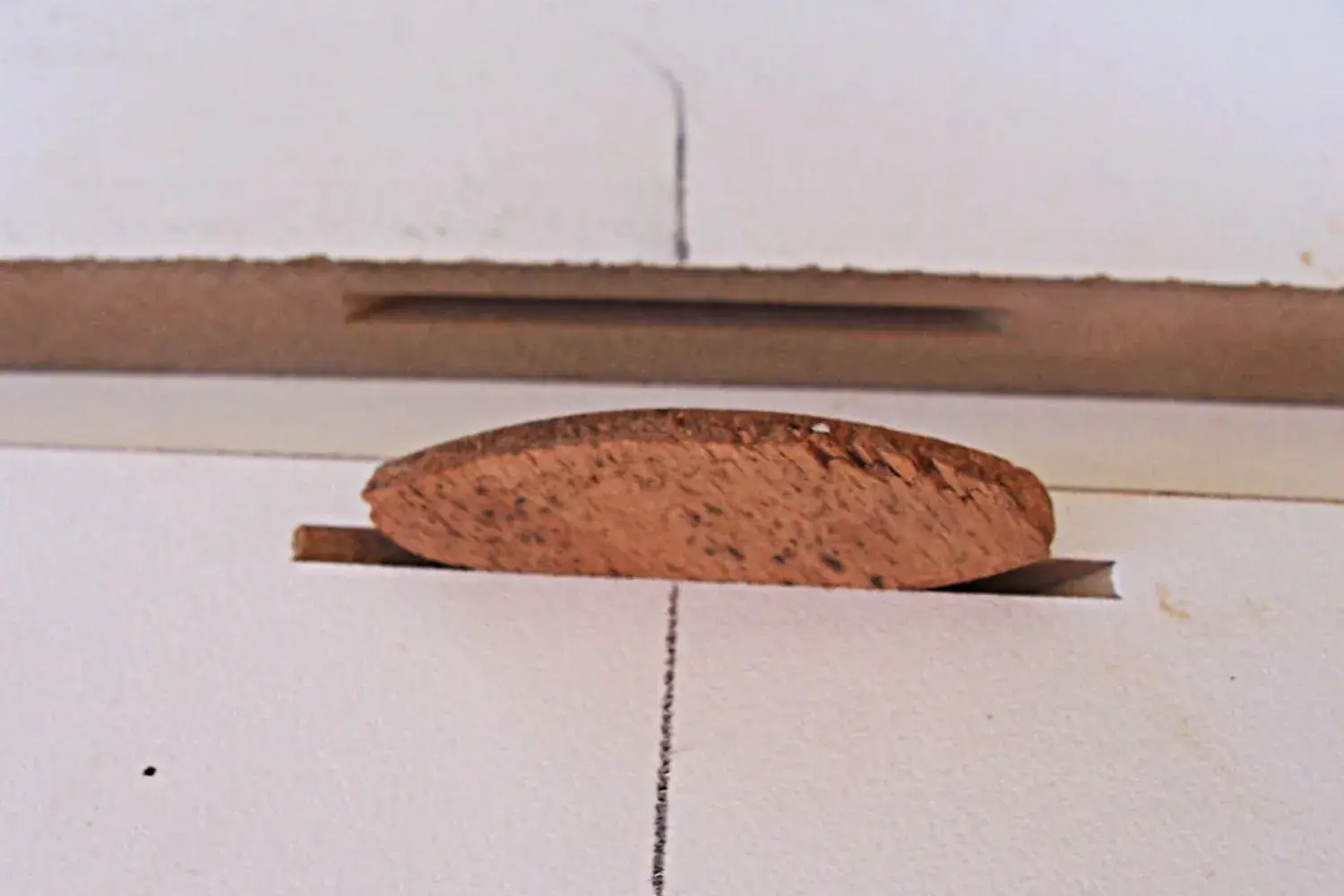
How it works: A biscuit joiner (plate joiner) cuts matching crescent-shaped slots. A compressed beech “biscuit” goes in with glue, swelling as it absorbs moisture from the glue.
Strengths
- Excellent for alignment — keeping edges flush during panel glue-ups and carcass assembly.
- The slots are slightly longer than the biscuit, giving you a bit of side-to-side adjustment.
- Quick and fully hidden.
Weaknesses
- In edge-to-edge panel glue-ups, a properly glued long-grain joint is already strong; biscuits mostly help alignment, not strength.
- Less strength in frame joints (like a rail into a leg) than a mortise and tenon or a well-sized dowel joint.
- Requires a dedicated tool.
So which should you use?
| Situation | Good choice |
|---|---|
| Shop cabinets, face frames, quick builds | Pocket holes |
| Aligning boards in a tabletop glue-up | Biscuits (or just careful clamping) |
| Hidden joints in a small table or chair where you don’t want screws | Dowels |
| Heavy-duty frames that take racking forces (table legs, chair rails) | Consider a mortise and tenon |
There’s no single “best” joint. A good rule: use the simplest joint that’s strong enough for the job and that you can execute accurately. And as always, follow your jig or tool manufacturer’s instructions for setup and bit/screw selection.
Want to put dowels or loose tenons to work? The Shaker-style side table is a great next project.